
1. What Exactly Is Long-Term Coaching?
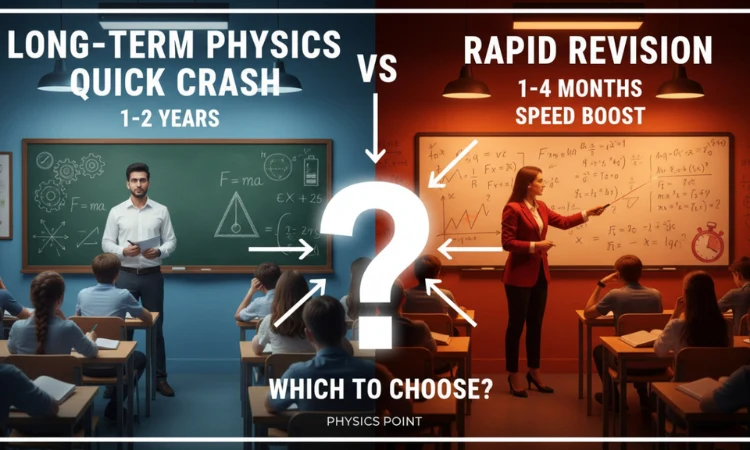
When we talk about long-term coaching, think of this as building the physics—each set and problem at a time. Long-term coaching generally spans for around 1 or 2 years and does cover classes like 11th or 12th (or even the drop year—if you opted for that). This is not about rushing but about building a foundation that’s strong and solid.
- How This Works
You get the right coverage for each topic, and this is explained well at every step. You get regular testing that’s either weekly or monthly for tracking your progress in physics. Special doubt-clearing sessions are held whether you’re getting stuck in some concept, along with regular assignments to improve your practice. Different concepts like electromagnetism, Newton’s Laws, and some other concepts can take a long time to understand and comprehend.
- Who is This For:
Great for students that are starting in a fresh way, as in class 11th, and those students that need time for understanding, or anyone that wants stress-free and steady learning. If you have the time for truly understanding physics, not just to pass but more.
2. What exactly is a short-term course?
- How This Works
- Who is This For:
3. Let’s Compare: Side-by-Side Clarity
Still not sure which one to choose. This comparison table will help you out:
Factor | Long-Term Coaching | Crash Course |
Duration | 1 to 2 years | 1 to 4 months |
Depth | Complete & Comprehensive & builds concepts | Quick & fast, focused on major points & tricks |
Best For | Beginners & building strong concepts | Final revision of concepts & last-minute helps |
Practice | Regular assignments, chapter tests | Mock tests, Past Year Questions (PYQs) |
Cost | Higher (long duration) | Moderate (short duration) |
The Good, the Bad, and the Realistic
- Long-Term Coaching:
- Pros: Creation of an unshakable foundation and ensures that each and every topic is well understood and helps in the development of problem-solving stamina with consistent practice and can reduce last-minute panic.
- Cons: Needs a serious time commitment, and this can be draining and intensive at times. The costs are higher and require complete discipline to finish the course.
- Crash Course:
- Pros: Fast-paced and sharpens the exam strategy and hard practice for timed conditions, plus lower costs overall.
- Cons: It does not fix the problem regarding understanding fundamentals, and these courses can be tough. High pressure on students because of fast-paced learning.
How do you decide between these courses?
Just ask these basic questions:
- Are you starting class 11th or 12th? And want long-term coaching? – If this is the case, this is a great choice for you. You need to have time and use that for building rock-solid understanding.
- Are you in class 12 and want to cover the syllabus fast? In that case, choose a crash course for fast revision along with the test practice.
- Are you struggling with basic concepts? – Then go for a long-term course, and in this course a crash course will not work.
- Are you confident with concepts but not speedy and solve problems and questions slowly? – In that case, go for a crash course, as it can help you with the speed.