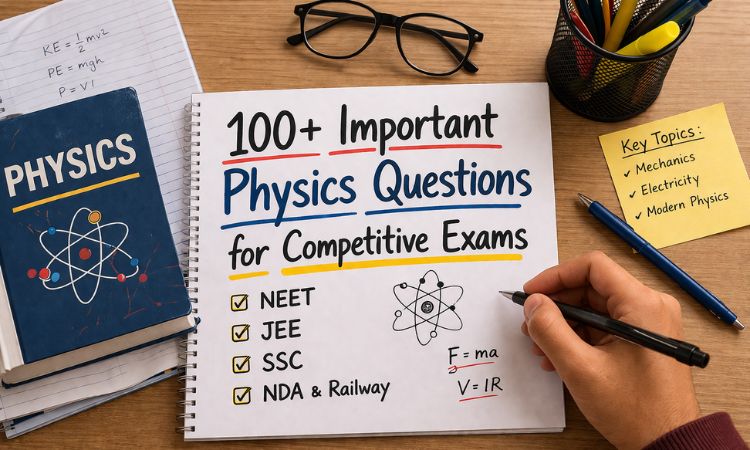
Physics plays a crucial role in securing a rank in many of India’s major competitive examinations, such as JEE, NEET, and others. You must possess a strong command over key physics concepts and problems, as this helps you achieve better results in exams like NEET, JEE, SSC, NDA, and Railway recruitment tests.
Furthermore, throughout your entire physics exam preparation journey, you require consistent hard work, proper guidance, the right strategy, and a focused approach toward the important physics questions that typically appear in these competitive exams.
Here, we will discuss 100+ important physics questions for competitive exams in detail.
Why Physics Questions Practice is Important
Studying physics questions enables you to reach a full understanding of scientific principles. This helps you to enhance your ability to succeed in competitive assessments. Here are the reasons why physics practice questions are important:
Improve Concept Clarity
Practicing Physics Questions stems from its ability to assist you with your academic needs. You can clear your concept through physics practice.
Helps in Competitive Exams
If you practice physics problems, you must develop a complete understanding of concepts. Your understanding of fundamental concepts increases when you solve actual problems using theoretical knowledge.
Improves Problem-Solving Speed
Science subjects make up a significant part of NEE, JEE, SSC, NDA, and railway examinations. Your regular practice of solving physics multiple-choice questions enhances your exam performance. It leads to higher selection chances.
Most Important Physics Questions with Answers
If you practice JEE physics questions, it will help you improve your understanding of content. It leads to better memory retention.
Here are the essential physics sections which contain physics MCQ:
Mechanics Questions
- What is the SI unit of force?
Answer: Newton - What is acceleration due to gravity on Earth?
Answer: 9.8 m/s² - What is the unit of work?
Answer: Joule - What is momentum?
Answer: Momentum = Mass × Velocity - What is the SI unit of power?
Answer: Watt - What is inertia?
Answer: The tendency of an object to resist changes in its state of motion - What is velocity?
Answer: Speed with direction - What is the formula of kinetic energy?
Answer: KE = 1/2 mv² - What is potential energy?
Answer: Energy due to position - What is the unit of pressure?
Answer: Pascal - What is Newton’s First Law?
Answer: Law of inertia - What is impulse?
Answer: Impulse = Force × Time - What is uniform motion?
Answer: Equal distance covered in equal intervals of time - What is non-uniform motion?
Answer: Unequal distance covered in equal intervals of time - What is speed?
Answer: Distance/time - What is displacement?
Answer: Shortest distance between two points - What is the work formula?
Answer: W = F × d - What is energy?
Answer: Capacity to do work - What is mass?
Answer: Quantity of matter in a body - What is friction?
Answer: Force that opposes motion
Electricity Questions
- What is Ohm’s Law?
Answer: V = IR - What is the SI unit of current?
Answer: Ampere - What is resistance?
Answer: Opposition to the flow of current - What is voltage?
Answer: Potential difference between two points - What is the unit of resistance?
Answer: Ohm - What is electric power?
Answer: P = VI - What is a conductor?
Answer: Material that allows current to pass - What is an insulator?
Answer: Material that blocks current - What is the unit of electric charge?
Answer: Coulomb - What is a series circuit?
Answer: Same current flows through all components - What is a parallel circuit?
Answer: Same voltage across all branches - What is a fuse?
Answer: Safety device to protect circuits - What is a battery?
Answer: Source of electrical energy - What is capacitance?
Answer: Ability to store charge - What is an electric field?
Answer: Force per unit charge - What is current formula?
Answer: I = Q/t - What is EMF?
Answer: Energy per unit charge - What is a resistor?
Answer: Device that limits current - What is a short circuit?
Answer: Low resistance path between two points - What is the unit of power?
Answer: Watt
Modern Physics Questions
- Who discovered the electron?
Answer: J.J. Thomson - What is the photoelectric effect?
Answer: Emission of electrons due to light - Who proposed the atomic model?
Answer: Bohr - What is a nucleus?
Answer: Central part of an atom - What is proton charge?
Answer: Positive - What is neutron charge?
Answer: Neutral - What is electron charge?
Answer: Negative - What is radioactivity?
Answer: Emission of radiation - What is an isotope?
Answer: Same element with different mass numbers - What is half-life?
Answer: Time required for half decay - What is fission?
Answer: Splitting of nucleus - What is fusion?
Answer: Combination of nuclei - What is a photon?
Answer: Particle of light - What is Planck constant?
Answer: 6.626 × 10⁻³⁴ Js - What is X-ray?
Answer: High energy radiation - What is gamma ray?
Answer: Highest energy radiation - What is an alpha particle?
Answer: Helium nucleus - What is a beta particle?
Answer: Electron-like particle - What is quantum theory?
Answer: Energy exists in discrete packets - What is energy formula?
Answer: E = mc²
Physics Questions for NEET & JEE
Competitive exams like NEET and JEE focus heavily on concept-based and numerical problem-solving. So, practicing JEE and NEET physics questions is very important.
Here are important JEE and NEET physics questions:
- A body moves with constant velocity. What is acceleration?
Answer: Zero - What is the force on 2 kg mass with 3 m/s² acceleration?
Answer: F = Mass × Acceleration = 2 × 3 N = 6 N - What is the work done if force is zero?
Answer: Zero - What is the Momentum of a 5 kg body at 2 m/s?
Answer: Momentum = Mass × Velocity = 5 × 2 kg·m/s = 10 kg·m/s - What is Kinetic energy of 2 kg at 3 m/s?
Answer: KE = 1/2 mv² = 9 J
KE = Kinetic Energy
m = Mass of the object
v = Velocity of the object - What is the Potential energy formula?
Answer: PE = m × g × h
PE = Potential Energy
m = Mass of the object
g = Acceleration due to gravity
h = Height of the object above the ground - What is the unit of gravitational force?
Answer: Newton - What is the current formula?
Answer: I = Q/t
I = Electric Current
Q = Electric Charge
t = Time Taken - What is the Voltage formula?
Answer: V = IR
V = Voltage
I = Electric Current
R = Resistance - What is a Resistance unit?
Answer: Ohm - What is the Power formula?
Answer: P = VI
P = Power
V = Voltage
I = Electric Current - What is a Frequency unit?
Answer: Hertz - What is the Wave speed formula?
Answer: v = fλ
v = Wave Speed
f = Frequency of the wave
λ (lambda) = Wavelength - What is the Acceleration formula?
Answer: a = (v – u)/t
a = Acceleration
v = Final Velocity
u = Initial Velocity
t = Time Taken - What is the Work formula?
Answer: W = Force × Distance - What is the Energy unit?
Answer: Joule - What is the Mass unit?
Answer: kg - What is the Force formula?
Answer: F = Mass × Acceleration - What is the Speed formula?
Answer: distance/time - What is the Density formula?
Answer: mass/volume - What is the Pressure formula?
Answer: Force/area - What is the Heat unit?
Answer: Joule - What is the Sound speed in air?
Answer: 343 m/s - What is Light Speed?
Answer: 3 × 10⁸ m/s - What is Ohm’s Law?
Answer: V = IR
V = Voltage
I = Electric Current
R = Resistance - What is the Capacitance unit?
Answer: Farad - What is the Charge unit?
Answer: Coulomb - What is the Energy of Photons?
Answer: E = hν
E = Energy of the photon
h = Planck’s Constant (6.626 × 10⁻³⁴ J·s)
ν (nu) = Frequency of the radiation - What is the Planck constant?
Answer: 6.626 × 10⁻³⁴ - What is the Work-energy theorem?
Answer: Work = change in KE - What is Newton’s 2nd law?
Answer: F = ma
F = Force
m = Mass
a = Acceleration - What is the Acceleration unit?
Answer: m/s² - What is the Power unit?
Answer: Watt - What is an Electric field unit?
Answer: N/C - What is a magnetic field unit?
Answer: Tesla - What is the Resistance formula?
Answer: R = V/I
R = Resistance
V = Voltage
I = Electric Current - What is an EMF unit?
Answer: Volt - What is the Energy formula?
Answer: E = mc² - What is the Frequency formula?
Answer: 1/T - What is a Period unit?
Answer: Second - What is the Lens formula?
Answer: 1/f = 1/v + 1/u - What is the Mirror formula?
Answer: 1/f = 1/v + 1/u - What is the Momentum unit?
Answer: kg·m/s - What is the Impulse unit?
Answer: Ns - What is the Power formula (mechanical)?
Answer: Work/time - What is the Density unit?
Answer: kg/m³ - What is the Heat formula?
Answer: Q = mcΔT
Q = Heat energy
m = Mass of the substance
c = Specific Heat Capacity of the substance
ΔT (Delta T) = Change in Temperature - What is the Efficiency formula?
Answer: output/input × 100 - What is the acceleration due to gravity?
Answer: 9.8 m/s² - What is the Law of conservation of energy?
Answer: Energy cannot be created or destroyed
100 Important Physics Questions PDF
Easy Tricks to Solve Physics Questions Faster:
The correct techniques enable you to solve physics problems with greater speed and better efficiency. Here are some easy physics tricks to solve Physics questions faster:
- Learn all important formulas and revise them regularly.
- Practice previous year physics questions for competitive exams daily.
- Focus on understanding concepts instead of rote learning.
- Solve physics numerical problems every day to improve speed.
- Use physics shortcuts and methods for calculations wherever possible.
- Analyze your mistakes after solving mock tests.
- Maintain a formula sheet for quick revision.
Common Mistakes Students Make in Physics:
Many students lose marks because they make physics preparation mistakes. Here are some common physics study mistakes students make in Physics:
- Memorizing formulas without understanding concepts.
- Ignoring units while solving problems.
- Not practicing enough numerical questions.
- Skipping revision of important topics.
- Not analyzing mistakes in mock tests.
- Rushing through questions without reading properly.
- Avoiding difficult topics instead of practicing them.
Conclusion:
To get success, you should conduct repeated practice of essential physics questions and answers. Your understanding of concepts will improve while your confidence level will rise and your capacity to solve problems will increase. Consistent practice of physics MCQ helps you achieve better results in your competitive exams like NEET and JEE examinations.
To achieve top scores, you combine concept learning with regular question practice. To enhance your study process you should keep practicing and maintaining your current activities while you investigate additional physics practice materials. Practice more and give your best. All the best!