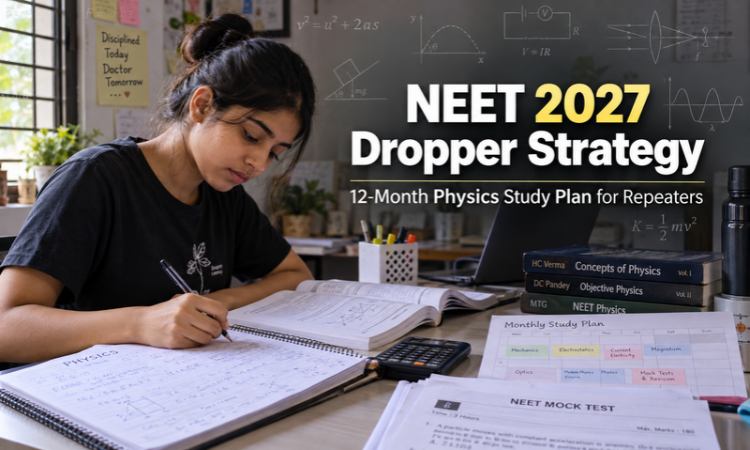
Preparing for NEET 2027 as a dropper gives you another opportunity to improve your performance, but repeating the same study routine may not produce better results. Many repeaters understand Physics concepts but struggle with numerical problems, formula application, calculation errors and time management during mock tests.
The right NEET 2027 Dropper Strategy should focus on identifying these weaknesses, strengthening concepts and practising questions consistently. Instead of spending the entire day watching lectures, combine focused learning with independent problem-solving, previous-year questions (PYQs) and regular revision.
This 12-month Physics study plan will help you organise your preparation, track progress and build the confidence to approach unfamiliar questions. If your goal is to score 700+ in NEET 2027, remember that Physics is only one part of your overall preparation; Biology, Chemistry, accuracy and consistency also matter.
Understand Your Physics Preparation Level First
Before starting a new timetable, identify why your previous preparation did not produce the result you wanted.
Weak concepts: Revisit the theory, understand the underlying principles and practise basic questions before attempting difficult numericals.
Poor numerical accuracy: Focus on formula selection, unit conversions, calculations and multi-step problems.
Incomplete syllabus: Divide pending chapters into weekly targets and complete them alongside regular revision.
Low mock-test scores: Analyse incorrect, guessed and time-consuming answers instead of repeatedly taking tests without reviewing them.
This self-assessment helps you build a personalised NEET 2027 Physics Preparation plan instead of following a routine designed for someone else.
NEET 2027 Physics Study Plan: Month-Wise Roadmap
Use this 12-month roadmap as a starting point. Adjust the sequence according to your current preparation level, coaching schedule and the official NEET UG 2027 syllabus.
Month | Physics topics and targets |
|---|---|
1 | Physics and Measurement, Kinematics, Laws of Motion |
2 | Work, Energy and Power; Rotational Motion |
3 | Gravitation, Properties of Solids and Liquids, thermal physics basics |
4 | Thermodynamics, Kinetic Theory, Oscillations and Waves |
5 | Electrostatics and Current Electricity |
6 | Magnetic Effects of Current and Magnetism, EMI and AC |
7 | Electromagnetic Waves and Ray Optics |
8 | Wave Optics, Dual Nature, Atoms, Nuclei and Electronic Devices |
9 | Complete syllabus revision and chapter-wise PYQs |
10 | Mixed-topic practice and weak-chapter revision |
11 | Full-length mock tests and detailed performance analysis |
12 | Final revision, formula recall and exam simulation |
The official NEET UG 2026 syllabus is a useful provisional reference, but the separate NEET UG 2027 syllabus should be checked when officially released. Do not assume that an older chapter list automatically matches the applicable syllabus.
Important: If you have already completed Physics once, do not spend months repeating every lecture. Take a diagnostic test and dedicate more time to the chapters and question types where you consistently struggle.
Also Read : NEET Physics Preparation in 60 Days
Daily Timetable for NEET Physics Droppers
A consistent routine is more valuable than an unrealistic timetable that you cannot maintain. Here is a sample two-hour Physics schedule that you can adjust around Biology, Chemistry and coaching classes.
Activity | Time |
|---|---|
Concept revision or lecture | 35 minutes |
Independent MCQ and numerical practice | 45 minutes |
Formula revision and active recall | 20 minutes |
Mistake analysis | 20 minutes |
Total | 2 hours |
If your fundamentals are weak, allocate more time to concept learning. If you have already completed the syllabus, prioritise timed practice, mixed-topic questions and revision.
How Many Physics Questions Should You Solve Daily?
Aim for approximately 30–50 focused questions on a regular practice day, depending on the chapter’s difficulty and your preparation level. Review every incorrect answer instead of chasing a high question count.
Use a balanced mix of:
Basic MCQs to check conceptual understanding.
Numerical problems requiring multiple steps.
Authentic NEET previous-year questions.
Mixed-topic questions to practise selecting the correct concept.
Previously incorrect questions to measure improvement.
Maintain a mistake notebook and classify errors as conceptual, formula-related, calculation-based or caused by misreading the question. Reattempt these questions after a few days without checking the solution.
Formula Revision and Mock-Test Strategy
Physics formulas become useful when you understand their meaning, units and application. For each important equation, note what the symbols represent, the conditions under which the equation applies and one example of its use.
Revise formulas on the day you learn them, revisit them during weekly revision and test yourself through mixed MCQs.
For mock tests, gradually progress from chapter-wise assessments to full-length tests. After each test, review incorrect answers, lucky guesses, lengthy calculations and questions you left unanswered despite knowing the concept.
Track your accuracy and recurring errors over several tests. Improving these patterns is a more useful indicator of progress than one unusually high score.
A focused NEET 2027 Dropper Strategy should also include regular revision of completed chapters while you study new ones. Otherwise, you may finish the syllabus but struggle to recall earlier concepts during the examination.
Common Mistakes NEET Repeaters Should Avoid
Watching too many lectures: Follow each lecture with independent question practice.
Changing books repeatedly: Use a limited set of reliable study resources and complete them properly.
Ignoring weak chapters: Address conceptual gaps instead of revising only your favourite topics.
Skipping experimental skills: Include the topics prescribed in the applicable official syllabus.
Taking mock tests without analysis: Spend time understanding why you lost marks.
Neglecting other subjects: Maintain a balanced preparation plan for Physics, Chemistry and Biology.
The official NTA website currently provides the NEET UG 2026 syllabus. Check for the separate 2027 syllabus before finalising your chapter checklist.
When Should You Join Physics Classes for NEET 2027?
Self-study is effective when you understand concepts and can solve questions independently. But if you repeatedly get stuck on the same numericals, cannot identify the right formula or understand solutions only after watching someone solve them, you may need more structured guidance.
Students with weak Physics fundamentals can consider offline or online Physics tuition based on their learning preferences, schedule and access to a suitable teacher. Look for classes that explain concepts from the basics, provide individual doubt-solving support and include regular question practice.
The aim is not to attend more lectures. It is to become capable of solving questions independently.
Need help improving your NEET Physics preparation?
If you are a NEET 2027 dropper struggling with Physics concepts, numerical questions or mock-test accuracy, consider getting structured guidance from an experienced Physics teacher.
Choose classes that focus on concept clarity, individual doubts, regular practice and measurable progress rather than promises of a particular score or rank.
Conclusion
A consistent NEET 2027 Dropper Strategy combines strong fundamentals, regular numerical practice, formula revision, PYQs and mock-test analysis. Use the first phase of your preparation to build understanding, the middle phase to complete and revise the syllabus, and the final phase to improve exam readiness.
Do not measure progress only by study hours or completed chapters. Measure it by your ability to solve unfamiliar questions independently, reduce repeated mistakes and improve performance over time.
Frequently Asked Questions
How should I start preparing for NEET 2027 Physics as a dropper?
Begin with a diagnostic test, identify weak chapters and create a realistic timetable. Combine concept learning, question practice, PYQs and revision from the beginning.
Is 12 months enough for NEET Physics preparation?
Twelve months can provide a useful preparation window, but your progress depends on your starting level, consistency, syllabus coverage and quality of practice. No timetable guarantees a particular score.
How many hours should I study Physics daily?
There is no fixed requirement for every student. Allocate sufficient time for concepts, numericals and revision while maintaining a balanced schedule for all three NEET subjects.
How can I improve my Physics accuracy?
Review every incorrect and guessed answer, identify the underlying mistake and reattempt similar questions. Timed mixed-topic practice can help you improve both accuracy and speed.
Can I prepare for NEET Physics through self-study?
Yes, if you understand concepts independently, practise consistently and analyse your mistakes. If you remain stuck on fundamentals or numericals, consider additional guidance from a suitable Physics teacher.