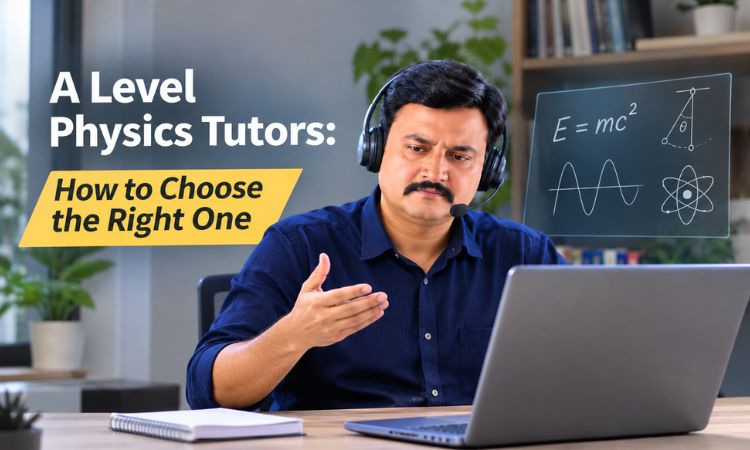
Choosing between the many A Level physics tutors available in the UK is much easier when you know what separates a good one from an average one. A Level Physics rewards students who properly understand the reasoning behind an answer, not just those who remember the correct equation. In 2026, only 11.4% of A Level Physics entries across all boards were awarded an A*.
Every difficult question asks students to apply the correct concepts, interpret information and make logical decisions using mathematics.
Developing this ability takes the right kind of guidance. An experienced A Level physics tutor helps students move beyond memorisation, understand the logic behind challenging topics and approach unfamiliar problems with confidence.
The difference lies in how well a tutor develops a student’s ability to think independently, not just how much of the syllabus they can cover.
When Should You Get an A Level Physics Tutor?
The right time to seek tuition is before a student’s difficulties begin affecting their overall performance. Experienced tutors can identify gaps in understanding, strengthen mathematical reasoning and help students develop the skills needed to tackle demanding exam questions.
Best Time to Start
Year 12 is an ideal starting point because it allows students to build strong foundations while learning new concepts. For those already in Year 13, starting 9 to 12 months before the final exams provides time to revisit challenging topics, practise past papers and improve exam technique. The December to January mock season is another important checkpoint for identifying weaknesses before final preparation begins.
Signs a Student Needs Extra Support
Extra tuition may be beneficial when a student:
- Repeatedly achieves the same grade despite putting in study hours.
- Struggles to connect mathematical methods with physics concepts.
- Understands the theory but loses marks on 6-mark questions.
- Finds practical investigations, data analysis or unfamiliar problems difficult.
A useful rule is simple: seek support when a student’s effort is no longer translating into measurable progress.
What Makes a Good A Level Physics Tutor?
A good tutor does more than explain complex concepts or help with homework. They understand the links between the science, the mathematics and the A Level Physics exam specifications. When comparing A Level physics tutors, look for subject expertise, exam-board knowledge and the ability to identify learning gaps, explain difficult ideas simply and turn subject knowledge into better problem-solving.
A Physics Specialist, Not a General STEM Tutor
A Level Physics covers demanding topics such as thermodynamics, electric fields, quantum phenomena and mechanics, which need more than general science knowledge. Look for a tutor with a Physics degree or relevant physics teaching experience. A specialist can explain the physical principle behind a formula, not just how to use it, and help students apply their understanding to unfamiliar problems.
Strong Mathematical Skills
Mathematics is central to A Level Physics. AQA and Edexcel require mathematical skills in at least 40% of their assessment. For example, students may need logarithms to analyse radioactive decay and interpret exponential relationships, or calculus to understand capacitor discharge. A good physics tutor for A Level students should explain both the calculations and their physical meaning, rather than presenting a string of steps.
Knowledge of the Student’s Exam Board
AQA (7408), Edexcel (9PH0) and OCR (H556) have different assessment structures, question styles and practical requirements. A tutor should know exactly which specification the student is studying and tailor lessons, practical preparation and past-paper practice to it, rather than follow a generic syllabus.
Past-Paper and Mark-Scheme Expertise
Ask how the tutor approaches 6-mark questions, required practicals and data-analysis problems. Students need to understand exactly what earns each mark, how to structure scientific explanations, how to read command words and how to avoid common mistakes. Regular past-paper practice should be followed by detailed feedback, not just a numerical score.
Online, In-Person or Group Classes: Which Format Works Best?
The best learning format depends on how much individual attention a student needs, how independently they study and where they struggle most. Each option offers a different balance of cost, flexibility and personalisation.
| Tuition Format | Cost | Flexibility | Personalisation | Best For |
|---|---|---|---|---|
| 1-to-1 Online | Moderate to high | High | Very high | Targeted support and flexible scheduling |
| 1-to-1 In-Person | High | Moderate | Very high | Students who learn better through face-to-face interaction |
| Small Group | Low to moderate | Moderate | Limited | Concept revision and collaborative learning |
An A Level physics tutor online can be particularly useful when local options are limited or when a student needs a specialist in a particular exam board. Online lessons also make it easier to arrange UK-time slots and revisit recorded sessions, where available. However, the real value of physics tuition comes from how effectively lessons address individual weaknesses, not simply whether they happen online or in person.
How Much Do A Level Physics Tutors Cost in the UK?
A Level physics tuition does not have one fixed price. Rates vary widely depending on the tutor’s background, the type of support offered and how often lessons take place. A lower hourly rate may look attractive, but the real value lies in how effectively the lessons improve a student’s understanding and exam performance.
What Affects the Price of A Level Physics Tuition?
- Tutor background: University students, physics graduates, qualified teachers, examiners and specialist providers are usually priced differently. In general, more experience and stronger credentials mean a higher rate.
- Exam-board expertise: A tutor who knows the AQA, Edexcel or OCR specification, past papers and mark schemes in depth offers more targeted support.
- Lesson format: One-to-one lessons usually cost more per hour than small groups. In-person lessons may also include travel costs, while online lessons often give access to a wider choice of tutors.
- Lesson length and frequency: Weekly lessons, longer sessions and intensive revision blocks before mocks and exams are priced differently.
- What is included: Past-paper practice, written feedback, progress reports, recordings and help between lessons can all add value beyond the lesson itself.
- Time of year: Demand rises around mock exams and final exams, so availability and rates can change.
How to Compare Tutor Prices Fairly
Rather than choosing on hourly rate alone, compare the full offer:
- Ask for the full cost in writing before booking, including any registration or agency fees.
- Check the policies: cancellation, missed lessons and refunds.
- Compare what is included, not just the rate. A slightly higher price with targeted feedback and past-paper support may need fewer sessions than a cheaper tutor teaching generically.
- Start with a trial lesson before paying for a package. Use the trial lesson test below to judge quality first.
To see current rates, you can browse tutor profiles on online tutoring platforms, or book a free trial lesson with Physics Point and ask about our current fees.
The 5-Step Trial Lesson Test: How to Evaluate a Physics Tutor
The first lesson shows whether a tutor can identify a student’s strengths and weaknesses and outline a plan to improve them. Don’t judge a tutor by confidence alone. Use these five checks to assess subject knowledge, problem-solving approach and exam preparation.
- Test their exam-question approach. Give them a past question from the student’s exam board. Do they explain the principles, the choice of equations and the marking criteria, or do they just show the answer?
- Check conceptual clarity. Ask them to explain a challenging topic such as simple harmonic motion. A good tutor should make the concept understandable while keeping it scientifically accurate.
- Evaluate their mathematical support. Ask them to rearrange an equation or work with logarithms, graphs or calculus. They should clearly link each mathematical technique to the physics problem.
- Ask for a study plan. It should identify weak topics, set revision targets, include past-paper practice and set realistic goals before the exams.
- Ask how they track progress. Look for regular checks on topic understanding, recurring errors, exam performance and topics that need more study.
Interested in trying out this approach with us? Schedule a free trial class.
Alternatively, you can download our free A Level Physics Tutor Scorecard (PDF) to compare tutors in terms of their teaching quality, their subject knowledge, mathematical assistance, and exam preparation before deciding who you want to work with.
Red Flags to Avoid When Choosing an A Level Physics Tutor
Not every tutor who promises better grades can deliver meaningful academic progress. Watch for these warning signs before committing to regular lessons:
- Unclear qualifications: They cannot provide details of their physics education or teaching experience.
- No trial lesson: They refuse to let students assess their teaching approach.
- Guaranteed grades: They promise specific results without assessing the student’s current ability.
- Identical lesson plans: They use the same teaching method regardless of individual learning gaps.
- No exam-board-specific resources: They cannot demonstrate familiarity with AQA, Edexcel or OCR specifications, past papers and mark schemes.
A reliable tutor should be transparent about their expertise, teaching methods and how they measure progress.
Conclusion
A strong result in A Level Physics starts with understanding the method, not just knowing how to use it. The right tutor will guide a student towards scientific reasoning, accuracy in exam questions and confidence with the mathematics.
Online tuition at Physics Point is aligned to the AQA, Edexcel and OCR specifications, so preparation matches the requirements of each exam board. Explore our A Level physics tutoring online, choose teaching that builds long-term understanding, and take the next step with a free trial lesson with Physics Point.
Frequently Asked Questions
How many hours of A Level physics tuition do most students need?
There is no fixed number. Many students start with one hour a week and increase to two hours closer to mock and final exams, depending on the size of their gaps. A short diagnostic lesson helps set the right amount.
Is a physics tutor better than a school revision class?
They do different jobs. School classes move at the pace of the whole group, while a tutor targets one student’s specific gaps. Many students benefit from using both.
Can one tutor help with both physics and maths?
Yes, and it can be very useful. Because maths is central to A Level Physics, a tutor who covers both can tell when a lost physics mark is really a maths gap and fix the right problem.